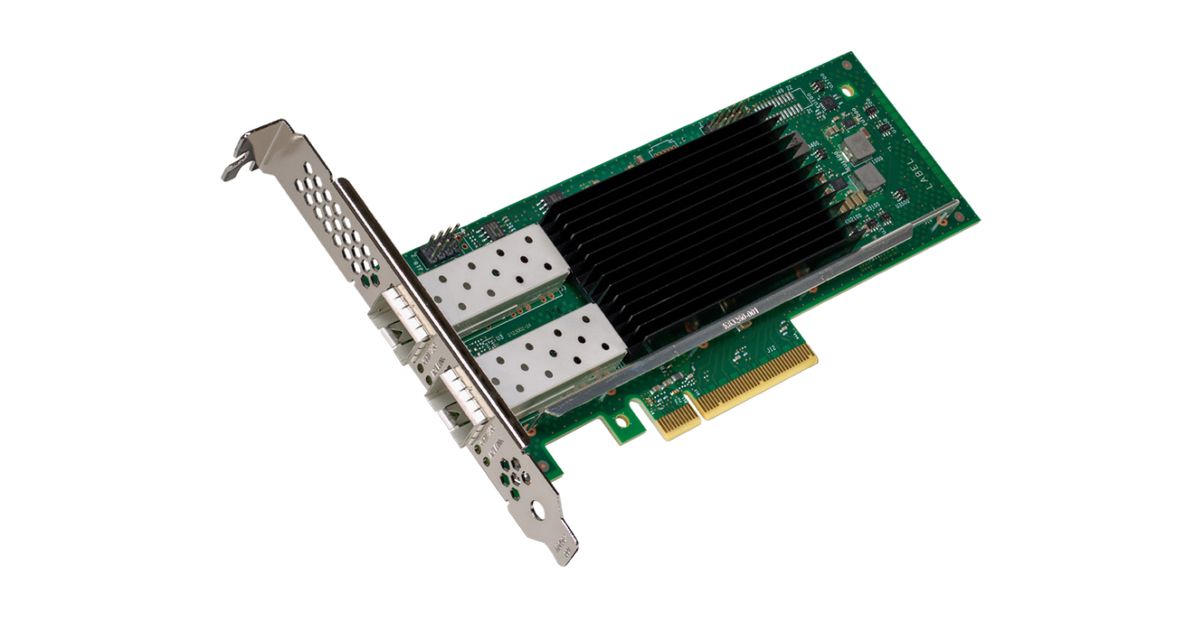
For illustrative purpose only
Intel E810-XXVDA2 Internal Fiber
Intel E810-XXVDA2, Internal, Wired, PCI Express, Fiber, Black, Green, Silver
Read more...
Read more...
Product Information
| Information | |
|---|---|
| Manufacturer | Intel |
| Product code | 167609202 |
| EAN | 00735858425773 |
| Manufacturer part number | E810XXVDA2G1P5 |
| Category | Võrgukaardid |
| Keyboard | |
|---|---|
| Connectivity technology | Wired |
| Ports & interfaces | |
|---|---|
| Host interface | PCI Express |
| Interface | Fiber |
| Fiber ports quantity | 2 |
| PCI version | 4.0 |
| Optical fiber | |
|---|---|
| Fiber optic connector | SFP28 |
| Other features | |
|---|---|
| Networking standards | IEEE 1588, IEEE 1588v2, IEEE 802.1p |
| Intel Virtual Machine Device Queues (VMDq) | Y |
| PCI-SIG* SR-IOV Capable | Y |
| On-chip QoS and Traffic Management | Y |
| Intel Flexible Port Partitioning | Y |
| Intelligent Offloads | Y |
| iWARP/RDMA | Y |
| Intel Data Direct I/O Technology | Y |
| Ethernet adapter ARK ID | 189760 |
| Storage Over Ethernet | iSCSI, NFS |
| Launch date | Q3'20 |
| Status | Launched |
| Network | |
|---|---|
| Ethernet interface type | 10 Gigabit Ethernet, 25 Gigabit Ethernet, Gigabit Ethernet |
| Ethernet LAN data rates | 1000,10000,25000 Mbit/s |
| Management features | |
|---|---|
| Quality of Service (QoS) support | Y |
| Performance | |
|---|---|
| Internal | Y |
| Design | |
|---|---|
| Component for | Server |
| Product colour | Black, Green, Silver |
| LED indicators | Activity, Link |
| Features | |
|---|---|
| Certification | FCC B, UL, CE, VCCI, BSMI, RCM, KCC |
| Operational conditions | |
|---|---|
| Operating temperature (T-T) | 0 - 55 °C |
| Storage temperature (T-T) | -40 - 70 °C |
| Weight & dimensions | |
|---|---|
| Width | 167 mm |
| Depth | 68 mm |
Product Description
iWARP/RDMA
iWARP delivers converged, low-latency fabric services to data centers through Remote Direct Memory Access (RDMA) over Ethernet. The key iWARP components that deliver low-latency are Kernel Bypass, Direct Data Placement, and Transport Acceleration.
Intel® Data Direct I/O Technology
Intel® Data Direct I/O Technology is a platform technology that improves I/O data processing efficiency for data delivery and data consumption from I/O devices. With Intel DDIO, Intel® Server Adapters and controllers talk directly to the processor cache without a detour via system memory, reducing latency, increasing system I/O bandwidth, and reducing power consumption.
PCI-SIG* SR-IOV Capable
Single-Root I/O Virtualization (SR-IOV) involves natively (directly) sharing a single I/O resource between multiple virtual machines. SR-IOV provides a mechanism by which a Single Root Function (for example a single Ethernet Port) can appear to be multiple separate physical devices.
Flexible Port Partitioning
Flexible Port Partitioning (FPP) technology utilizes industry standard PCI SIG SR-IOV to efficiently divide your physical Ethernet device into multiple virtual devices, providing Quality of Service by ensuring each process is assigned to a Virtual Function and is provided a fair share of the bandwidth.
Virtual Machine Device Queues (VMDq)
Virtual Machine Device Queues (VMDq) is a technology designed to offload some of the switching done in the VMM (Virtual Machine Monitor) to networking hardware specifically designed for this function. VMDq drastically reduces overhead associated with I/O switching in the VMM which greatly improves throughput and overall system performance
iWARP delivers converged, low-latency fabric services to data centers through Remote Direct Memory Access (RDMA) over Ethernet. The key iWARP components that deliver low-latency are Kernel Bypass, Direct Data Placement, and Transport Acceleration.
Intel® Data Direct I/O Technology
Intel® Data Direct I/O Technology is a platform technology that improves I/O data processing efficiency for data delivery and data consumption from I/O devices. With Intel DDIO, Intel® Server Adapters and controllers talk directly to the processor cache without a detour via system memory, reducing latency, increasing system I/O bandwidth, and reducing power consumption.
PCI-SIG* SR-IOV Capable
Single-Root I/O Virtualization (SR-IOV) involves natively (directly) sharing a single I/O resource between multiple virtual machines. SR-IOV provides a mechanism by which a Single Root Function (for example a single Ethernet Port) can appear to be multiple separate physical devices.
Flexible Port Partitioning
Flexible Port Partitioning (FPP) technology utilizes industry standard PCI SIG SR-IOV to efficiently divide your physical Ethernet device into multiple virtual devices, providing Quality of Service by ensuring each process is assigned to a Virtual Function and is provided a fair share of the bandwidth.
Virtual Machine Device Queues (VMDq)
Virtual Machine Device Queues (VMDq) is a technology designed to offload some of the switching done in the VMM (Virtual Machine Monitor) to networking hardware specifically designed for this function. VMDq drastically reduces overhead associated with I/O switching in the VMM which greatly improves throughput and overall system performance