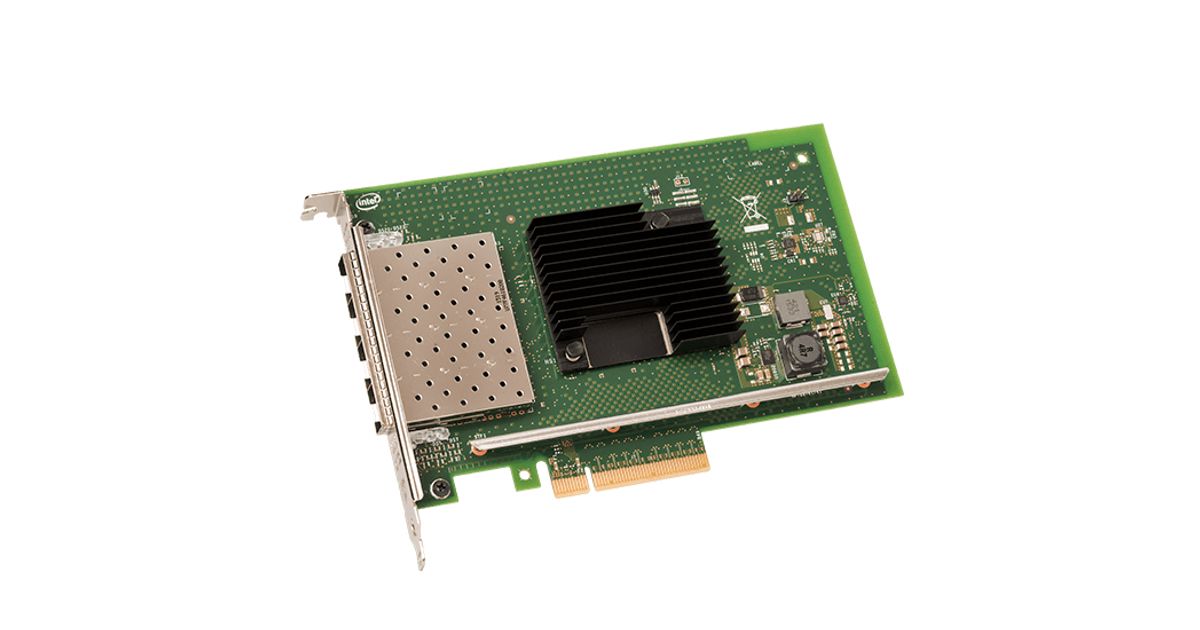
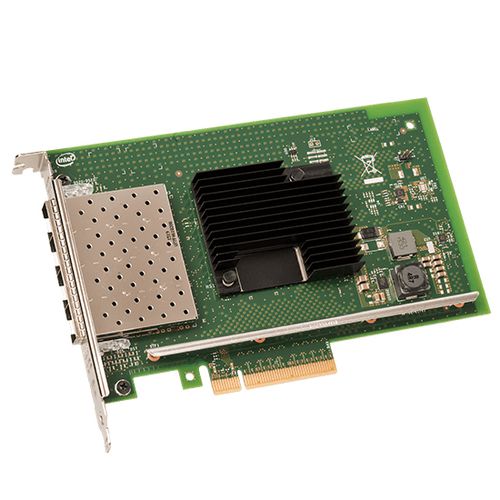
For illustrative purpose only
Intel X710DA4FHBLK network card Internal Fiber 10000 Mbit/s
Intel X710DA4FHBLK, Internal, Wired, PCI Express, Fiber, 10000 Mbit/s, Black, Green, Stainless steel
Read more...
Read more...
Product Information
| Information | |
|---|---|
| Manufacturer | Intel |
| Product code | 14377162 |
| EAN | 00735858281850 |
| Manufacturer part number | NKINLP4PPE00004 |
| Category | Network adapters |
| Keyboard | |
|---|---|
| Connectivity technology | Wired |
| Ports & interfaces | |
|---|---|
| Host interface | PCI Express |
| Interface | Fiber |
| Ethernet LAN (RJ-45) ports | 4 |
| Fiber ports quantity | 4 |
| PCI version | 3.0 |
| Interface type | PCIe v3.0 (8.0 GT/s) |
| Cabling type | SFP+ Direct Attached Twin Axial Cabling up to 10m |
| Optical fiber | |
|---|---|
| Fiber optic connector | SFP+ |
| Fiber ethernet cabling technology | 10GBASE-LR, 10GBASE-SR |
| Features | |
|---|---|
| Maximum data transfer rate | 10000 Mbit/s |
| Certification | FCC A, UL, CE, VCCI, BSMI, CTICK, KCC |
| Cable type | SFP+ Direct Attached Twin Axial Cabling up to 10m |
| Market segment | Server |
| Harmonized System (HS) code | 85176990 |
| Controller type | Intel® Ethernet Controller X710 |
| Network | |
|---|---|
| Ethernet LAN data rates | 10,1000 Mbit/s |
| Maximum operating distance | 10 m |
| LAN controller | Intel® X710 |
| Management features | |
|---|---|
| Quality of Service (QoS) support | Y |
| Performance | |
|---|---|
| Internal | Y |
| Export Control Classification Number (ECCN) | 5A991 |
| Commodity Classification Automated Tracking System (CCATS) | NA |
| Design | |
|---|---|
| Product colour | Black, Green, Stainless steel |
| LED indicators | Y |
| Product type | Network Interface Card |
| Other features | |
|---|---|
| Compatible operating systems | https://www.intel.com/content/www/us/en/support/articles/000025890/network-and-i-o/ethernet-products.html |
| Data transfer rate | 8 GT/s |
| Intel Virtual Machine Device Queues (VMDq) | Y |
| PCI-SIG* SR-IOV Capable | Y |
| On-chip QoS and Traffic Management | Y |
| Intel Flexible Port Partitioning | Y |
| Storage-over-ethernet | Y |
| Speed & slot width | 8.0 GT/s, x8 Lane |
| Low halogen options available | N |
| Intelligent Offloads | Y |
| iWARP/RDMA | N |
| Fiber Channel over Ethernet | N |
| Intel Ethernet Power Management | Y |
| Intel Data Direct I/O Technology | Y |
| Intel Virtualization Technology for Connectivity (VT-c) | Y |
| Ethernet adapter ARK ID | 83965 |
| Bracket height | Full-Height (FH) |
| Target market | Artificial Intelligence, High Performance Computing |
| Storage Over Ethernet | iSCSI NFS |
| Launch date | Q4'14 |
| Network interface card cable medium | Copper |
| Network interface card type | Server |
| Product brief URL | https://www.intel.com/content/www/us/en/ethernet-products/converged-network-adapters/ethernet-x710-brief.html |
| Status | Launched |
| Last change | 64826826 |
| Product family | Intel 10 Gigabit server adapter |
| Product series | 700 Series Network Adapters (up to 40GbE) |
| Product codename | Fortville |
| Operational conditions | |
|---|---|
| Operating temperature (T-T) | 0 - 55 °C |
| Storage temperature (T-T) | -40 - 70 °C |
| Operating relative humidity (H-H) | 0 - 90% |
| Weight & dimensions | |
|---|---|
| Width | 167 mm |
| Depth | 111 mm |
| Packaging data | |
|---|---|
| Quantity | 1 |
| Processor special features | |
|---|---|
| Conflict-Free | Y |
| Processor | |
|---|---|
| Processor family | 700 Network Adapters (up to 40GbE)-700 Network Adapters (up to 40GbE) |
Product Description
Flexible Port Partitioning
Flexible Port Partitioning (FPP) technology utilizes industry standard PCI SIG SR-IOV to efficiently divide your physical Ethernet device into multiple virtual devices, providing Quality of Service by ensuring each process is assigned to a Virtual Function and is provided a fair share of the bandwidth.
Virtual Machine Device Queues (VMDq)
Virtual Machine Device Queues (VMDq) is a technology designed to offload some of the switching done in the VMM (Virtual Machine Monitor) to networking hardware specifically designed for this function. VMDq drastically reduces overhead associated with I/O switching in the VMM which greatly improves throughput and overall system performance
PCI-SIG* SR-IOV Capable
Single-Root I/O Virtualization (SR-IOV) involves natively (directly) sharing a single I/O resource between multiple virtual machines. SR-IOV provides a mechanism by which a Single Root Function (for example a single Ethernet Port) can appear to be multiple separate physical devices.
Intel® Ethernet Power Management
Intel® Ethernet Power Management Technology provides solutions to common power management approaches by reducing idle power, reducing capacity and power as a function of demand, operating at maximum energy efficiency whenever possible, and enabling functionality only when needed.
Flexible Port Partitioning (FPP) technology utilizes industry standard PCI SIG SR-IOV to efficiently divide your physical Ethernet device into multiple virtual devices, providing Quality of Service by ensuring each process is assigned to a Virtual Function and is provided a fair share of the bandwidth.
Virtual Machine Device Queues (VMDq)
Virtual Machine Device Queues (VMDq) is a technology designed to offload some of the switching done in the VMM (Virtual Machine Monitor) to networking hardware specifically designed for this function. VMDq drastically reduces overhead associated with I/O switching in the VMM which greatly improves throughput and overall system performance
PCI-SIG* SR-IOV Capable
Single-Root I/O Virtualization (SR-IOV) involves natively (directly) sharing a single I/O resource between multiple virtual machines. SR-IOV provides a mechanism by which a Single Root Function (for example a single Ethernet Port) can appear to be multiple separate physical devices.
Intel® Ethernet Power Management
Intel® Ethernet Power Management Technology provides solutions to common power management approaches by reducing idle power, reducing capacity and power as a function of demand, operating at maximum energy efficiency whenever possible, and enabling functionality only when needed.