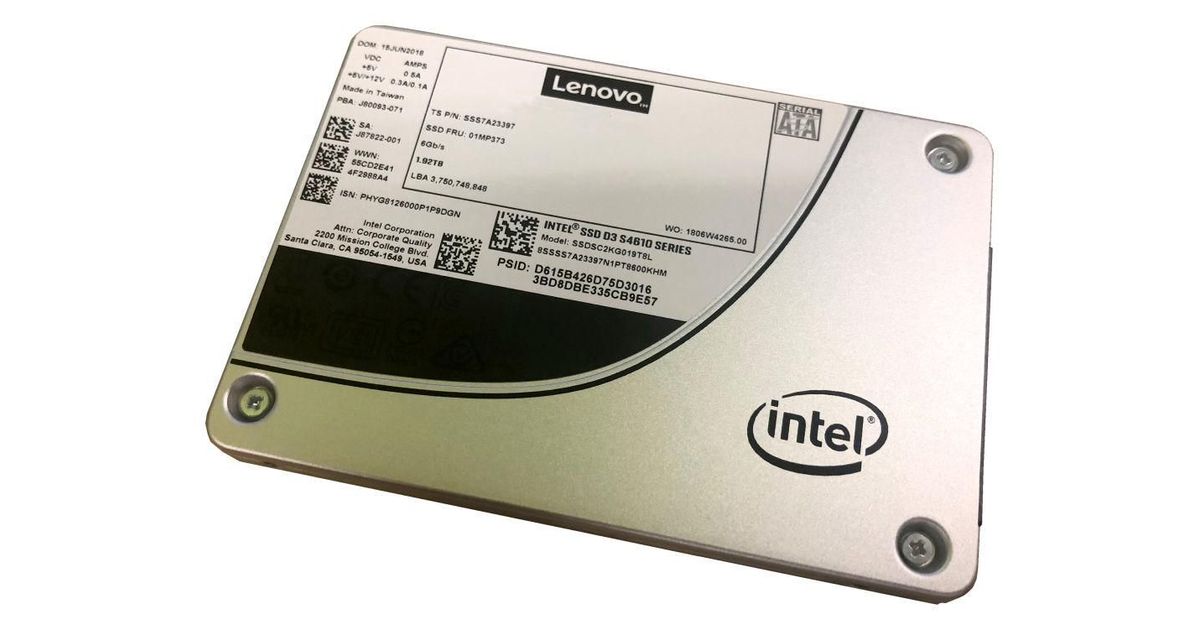
For illustrative purpose only
Lenovo Intel S4610 2.5" 1920 GB Serial ATA III 3D TLC NAND
Lenovo Intel S4610, 1920 GB, 2.5", 560 MB/s
Read more...
Read more...
Product Information
| Information | |
|---|---|
| Manufacturer | Lenovo |
| Product code | 228197559 |
| EAN | 00889488475346 |
| Manufacturer part number | 4XB7A13636 |
| Category | SSD kõvakettad |
| Features | |
|---|---|
| SSD form factor | 2.5" |
| Memory type | 3D TLC NAND |
| NVMe | N |
| Read speed | 560 MB/s |
| Write speed | 510 MB/s |
| Random read (4KB) | 97000 IOPS |
| Random write (4KB) | 51000 IOPS |
| Read latency | 36 µs |
| Write latency | 37 µs |
| Harmonized System (HS) code | 84717070 |
| Storage | |
|---|---|
| SSD capacity | 1920 GB |
| Ports & interfaces | |
|---|---|
| Interface | Serial ATA III |
| Design | |
|---|---|
| Component for | Server/workstation |
| Performance | |
|---|---|
| Hot-swap | Y |
| Mean time between failures (MTBF) | 2000000 h |
| Power | |
|---|---|
| Power consumption (average) | 2.8 W |
| Operational conditions | |
|---|---|
| Operating temperature (T-T) | 0 - 70 °C |
| Storage temperature (T-T) | -55 - 95 °C |
| Operating relative humidity (H-H) | 5 - 95% |
| Non-operating shock | 2.17 G |
| Maximum non-operating altitude | 3.13 m |
| Weight & dimensions | |
|---|---|
| Width | 70 mm |
| Depth | 100 mm |
| Height | 7 mm |
| Weight | 66 g |
Product Description
The Intel S4610 Mainstream SATA solid-state drives (SSDs) for Lenovo servers are advanced data center SSDs optimized for mixed read-write performance, endurance and strong data protection. Compared with the Intel S4600 series, these new drives offer improved performance and lower latency.
The Intel SSD S4610 drives with 3 full drives writes per day (DWD) are an excellent choice as cache in transactional application and high-speed storage for enterprise databases.
The Intel S4610 Enterprise Mainstream SATA solid-state drive is shown in the following figure.
The key difference between Performance SSDs such as the S3710 SSDs, Mainstream SSDs such as the S4610 SSDs, and Entry SSDs, such as the S4510 SSDs, is their endurance (life expectancy). SSDs have a huge, but finite, number of program/erase (P/E) cycles, which determines how long the drives can perform write operations and thus their life expectancy. Mainstream SSDs have better endurance than the Entry SSDs, but at a higher cost/IOPS ratio.
SSD write endurance is typically measured by the number of program/erase cycles that the drive can incur over its lifetime, which is listed as TBW in the device specification. The TBW value that is assigned to a solid-state device is the total bytes of written data that a drive can be guaranteed to complete. Reaching this limit does not cause the drive to immediately fail; the TBW simply denotes the maximum number of writes that can be guaranteed.
A solid-state device does not fail upon reaching the specified TBW, but at some point after surpassing the TBW value (and based on manufacturing variance margins), the drive reaches the end-of-life point, at which time the drive goes into read-only mode. Because of such behavior, careful planning must be done to use SSDs in the application environments to ensure that the TBW of the drive is not exceeded before the required life expectancy.
For example, the S4610 960 GB drive has an endurance of 6.0 PB of total bytes written (TBW). This means that for full operation over five years, write workload must be limited to no more than 3,288 GB of writes per day, which is equivalent to 3.4 full drive writes per day (DWPD). For the device to last three years, the drive write workload must be limited to no more than 5,479 GB of writes per day, which is equivalent to 5.7 full drive writes per day.
The Intel SSD S4610 drives with 3 full drives writes per day (DWD) are an excellent choice as cache in transactional application and high-speed storage for enterprise databases.
The Intel S4610 Enterprise Mainstream SATA solid-state drive is shown in the following figure.
The key difference between Performance SSDs such as the S3710 SSDs, Mainstream SSDs such as the S4610 SSDs, and Entry SSDs, such as the S4510 SSDs, is their endurance (life expectancy). SSDs have a huge, but finite, number of program/erase (P/E) cycles, which determines how long the drives can perform write operations and thus their life expectancy. Mainstream SSDs have better endurance than the Entry SSDs, but at a higher cost/IOPS ratio.
SSD write endurance is typically measured by the number of program/erase cycles that the drive can incur over its lifetime, which is listed as TBW in the device specification. The TBW value that is assigned to a solid-state device is the total bytes of written data that a drive can be guaranteed to complete. Reaching this limit does not cause the drive to immediately fail; the TBW simply denotes the maximum number of writes that can be guaranteed.
A solid-state device does not fail upon reaching the specified TBW, but at some point after surpassing the TBW value (and based on manufacturing variance margins), the drive reaches the end-of-life point, at which time the drive goes into read-only mode. Because of such behavior, careful planning must be done to use SSDs in the application environments to ensure that the TBW of the drive is not exceeded before the required life expectancy.
For example, the S4610 960 GB drive has an endurance of 6.0 PB of total bytes written (TBW). This means that for full operation over five years, write workload must be limited to no more than 3,288 GB of writes per day, which is equivalent to 3.4 full drive writes per day (DWPD). For the device to last three years, the drive write workload must be limited to no more than 5,479 GB of writes per day, which is equivalent to 5.7 full drive writes per day.